FAQ: HPC
Q13What is the HPC and what does it do?
The HPC (Hybrid Pulse Capacitor) is a critical internal component that works alongside the D-Cell battery. D-Cell LiSOCl₂ batteries offer high energy capacity but cannot supply the instantaneous high-current bursts required during radio transmissions and sensing operations. The HPC bridges this gap: it is charged by the D-Cell and discharges in pulses during peak demand.
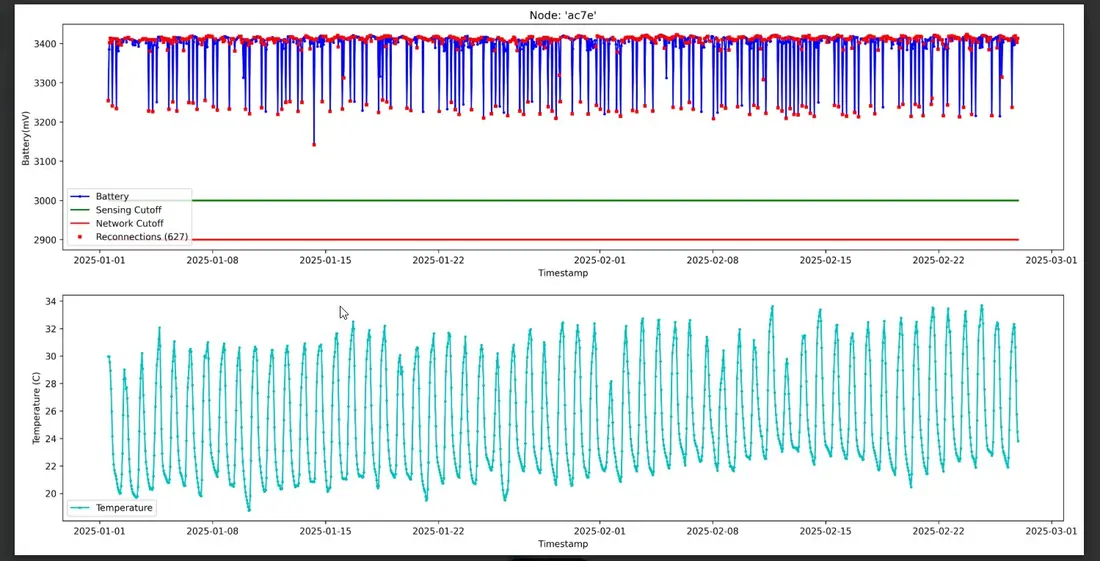
The voltage reading shown in the Snape dashboard is a combined value of both the D-Cell battery and the HPC.
Q14What are the HPC voltage thresholds and what do they mean?
- Above 3.0 V: Node collects sensor data normally and transmits to the Gateway. It also relays data for any child nodes.
- V: 3.0 V: Node stops collecting its own sensor data but remains on the Mesh network to relay data for child nodes.
- Below 2.9 V: Node enters deep sleep and disconnects from the network entirely.
- Below 2.5 V: HPC is deep discharged. Permanent damage can occur. The HPC must be replaced by the Ackcio team.
Even in deep sleep, the battery continues to drain. If the HPC reaches deep discharge (< 2.5 V), the node may produce erroneous readings and drain new batteries rapidly within 2 to 3 days.
Q15What is the correct procedure when a battery low warning appears in Snape?
Follow this procedure carefully: the sequence matters:
- Step 1: As soon as Snape shows a battery low icon, replace the D-Cell within 1 month. Do not delay.
- Step 2: Before replacing the battery, check the HPC voltage at the test point on the PCB (near the battery connector, marked with an orange circle in the HPC guide).
- Step 3: Measure HPC voltage BEFORE inserting the new D-Cell. Never measure HPC after inserting a new battery, the new battery spikes the HPC voltage and gives a false healthy reading.
- Step 4: If HPC is above 2.5 V → Safe to insert the new D-Cell and proceed normally.
- Step 5: If HPC is below 2.5 V → Do NOT insert a new D-Cell. A deep-discharged HPC will drain a brand new D-Cell within 2 to 3 days. Contact Ackcio support at support@ackcio.com immediately for HPC replacement.
Never slot a new D-Cell into a node with an HPC below 2.5 V, you will waste a new battery within days.
Q16How do I check the D-Cell battery voltage on-site?
LiSOCl₂ D-Cell batteries have a unique characteristic: they always read approximately 3.6 V on a multimeter whether new or depleted, this is inherent to the chemistry. A direct multimeter reading is therefore unreliable.
- Always measure D-Cell voltage with a load applied (i.e., while the battery is installed and the node is running).
- Do not rely on open-circuit voltage measurements for D-Cell batteries.
- Check the manufacturing date printed on the battery, use only batteries made within the last 3 months.
Q17How do I check the HPC voltage on-site?
The HPC can be measured directly using a multimeter, no load is required (unlike D-Cell batteries).
- Locate the HPC test point on the PCB: it is the soldering point near the battery connector, indicated in the Ackcio HPC guide (orange circle marker).
- Alternatively, you can measure directly on the HPC itself using a multimeter.
If visiting a site after 1+ month of a node being in battery-low state, always check HPC voltage before replacing the D-Cell.
Q18Can a client replace the HPC themselves?
The HPC is not a user-serviceable component. Dismantling the PCB to replace the HPC will void the product warranty.
Contact Ackcio support at support@ackcio.com to arrange an HPC replacement.
Q19Where can replacement HPC units be sourced?
Compatible HPC-1550 units are available from several suppliers. Contact Ackcio support at support@ackcio.com before sourcing: only Ackcio should perform the replacement.
HPC specifications: 3.6 V / 3.9 V max charge, 2.5 V discharge end voltage, max pulse current 3 A, temperature range −40°C to +85°C.
Q20What are the best practices to avoid HPC deep discharge?
- Replace the D-Cell within 1 month of the Snape battery low alert, do not wait.
- If a site visit is planned more than 1 month after the alert, bring a multimeter and check HPC voltage before replacing the battery.
- Only use D-Cell batteries manufactured within the last 3 months, check the manufacture date printed on the battery.
- Do not use stored batteries even if they appear new: LiSOCl₂ batteries self-discharge over time even without use.
- Never deploy a node without a D-Cell installed, running on HPC alone causes rapid deep discharge.
A deep-discharged HPC (< 2.5 V) causes erroneous sensor readings and may permanently damage the capacitor.
Q21Why do reboots occur on nodes, and what should be done?
Frequent reboots are typically caused by one of three issues:
- Insufficient battery: The battery cannot adequately power the system. Action: Replace with a fresh D-Cell manufactured within 3 months and monitor.
- Faulty or shorted sensor: Causes abnormally high current draw. Action: Inspect wiring and validate the sensor using the manufacturer's diagnostic tool.
- Node hardware failure: The node's power supply circuitry has failed. Action: Replace the node and inspect the battery connector.